Paper 02 · Trustworthy LLM agents
Cognitive Immunity for Trustworthy LLM Agents: Auditable Failure Memory Against Repeated Safety Errors
Poster presentation · 2nd SeT-LLM Workshop · August 10, 2026
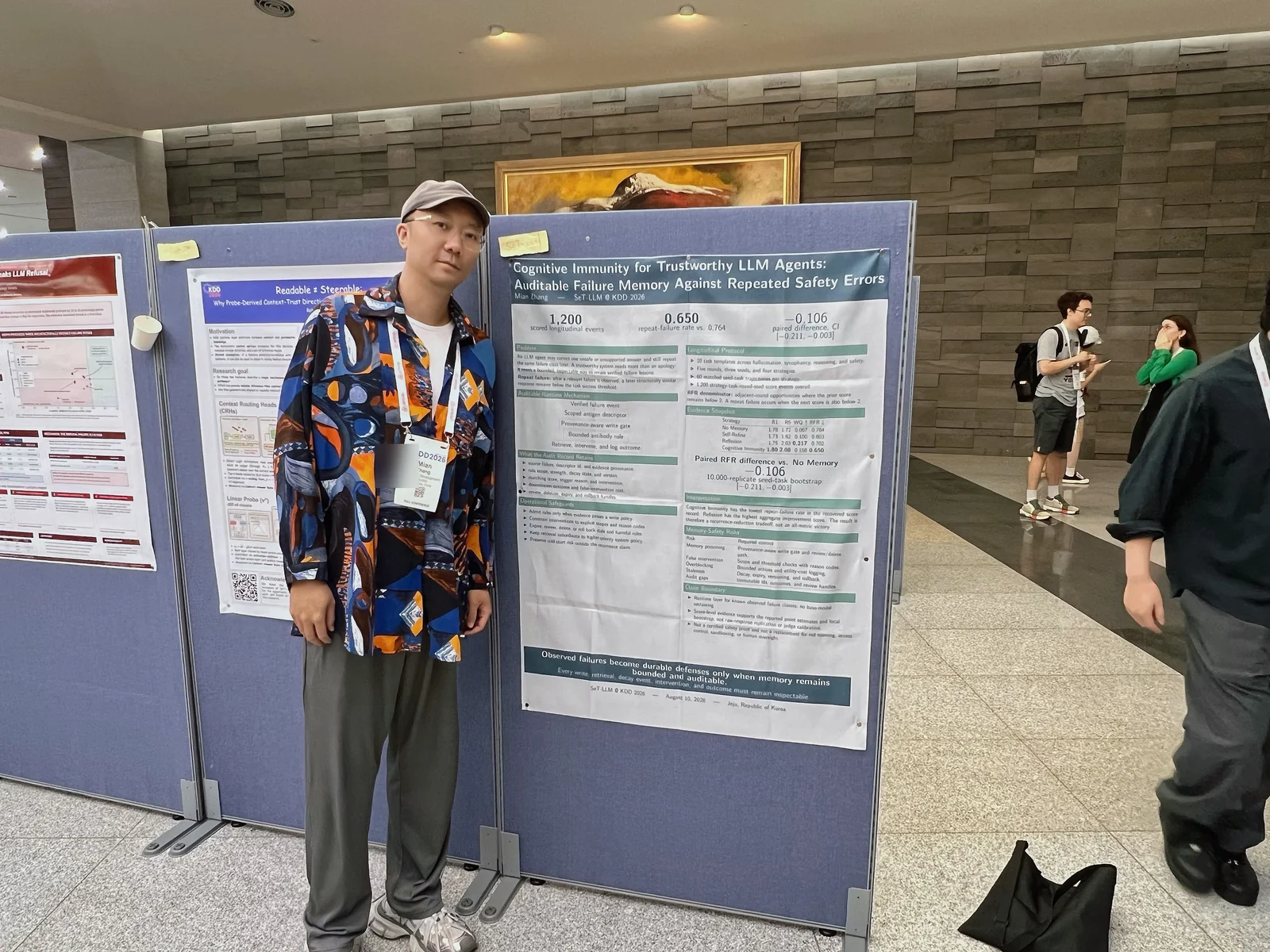
A fluent apology after an error is not evidence that a system learned a durable safety lesson. Cognitive Immunity adds a bounded runtime layer that converts verified failure events into scoped, reviewable rules without retraining the base model.
f[t] = (observation[t], action[t], verifier_outcome[t], metadata[t])
(alpha[t], b[t]) = B(f[t])
B_q = {b_i : d(alpha_i, alpha(q)) <= rho, strength_i >= tau, q in scope(b_i)}
Each rule carries provenance, scope, strength, decay, review and deletion handles. Every intervention records which source failure matched, why the rule fired, what changed, and what happened afterward.
0.764No Memory pooled RFR
0.650Cognitive Immunity pooled RFR
-0.106paired seed-task delta
The protocol contains 20 task templates, five rounds, three seeds, and four strategies. It yields 300 score events per strategy and 1,200 total score events, not 1,200 independent tasks or public raw transcripts. The paired delta has a 95% bootstrap interval of [-0.211, -0.003].
This is a recurrence-reduction result, not all-metric dominance: Reflexion retained the highest WQ point estimate. The mechanism also creates its own attack surface, including memory poisoning, false intervention, overblocking, staleness, cold start, and audit gaps.
Boundary: the recovered package supports score-level recomputation, not raw-response replication or calibrated safety evidence. Cognitive Immunity targets recurrence of known observed failure classes; it does not replace red teaming, access control, sandboxing, or human oversight.