Public Release - 2026-06-19

The hard part is not telling a stronger story. It is producing stronger evidence.

Artifact: evidence_production_machine_v1. This note defines a public review object for turning claims, objections, boundary changes, and next reviews into an inspectable record.

claim supporting_record objection counterexample_route boundary_update next_review
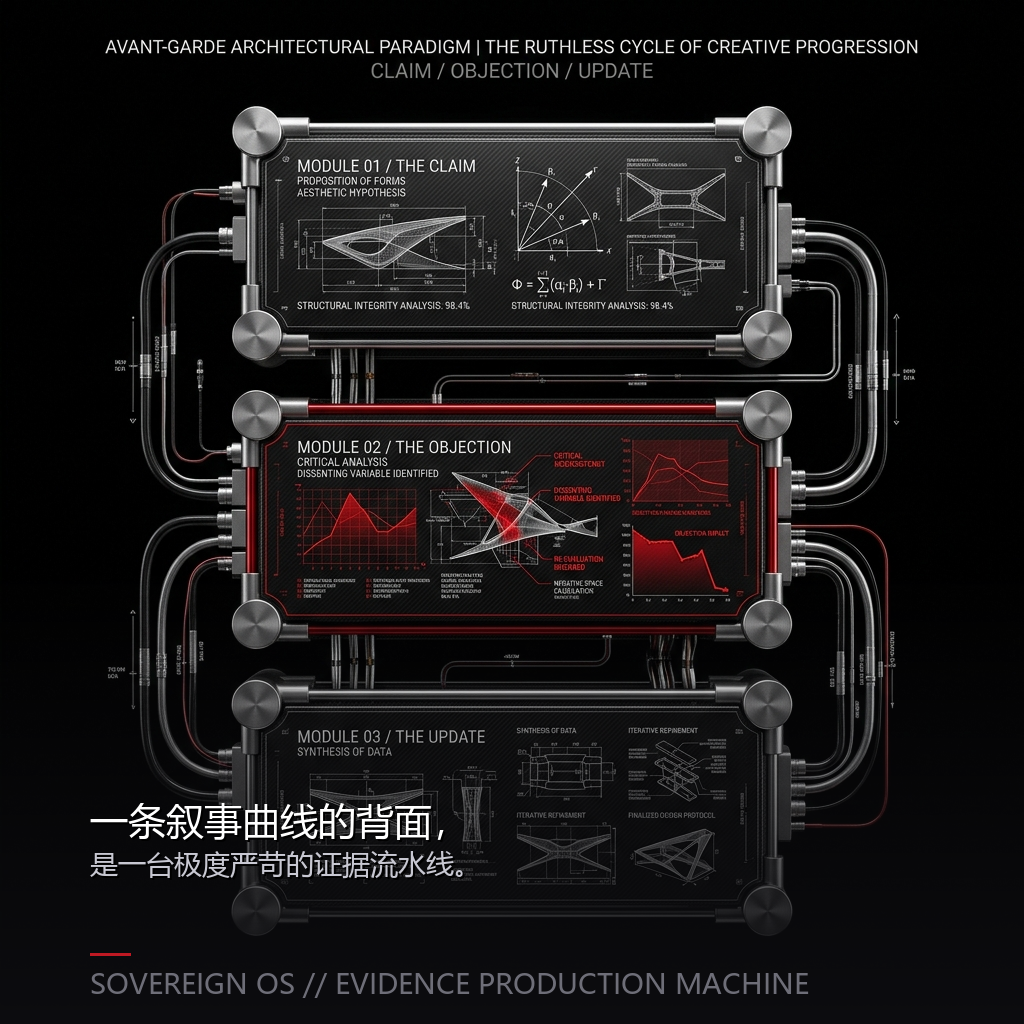
Evidence production machine visual mapping claims, objections, boundary updates, and review status.

Artifact

A narrative can be copied. A review record is harder to fake.

This update defines evidence_production_machine_v1, a public review object for technical readers who want to inspect how a claim changes after evidence, objection, and boundary review.

The object is not a financing story, valuation claim, customer commitment, or commercial promise. It is a field structure for making claims inspectable.
1

claim

The exact public claim under review, stated narrowly enough to be challenged.

2

supporting_record

The artifact, route, registry, paper, or observation that currently supports the claim.

3

objection

The strongest known challenge, missing control, failure mode, or unresolved comparison.

4

counterexample_route

The public route through which an external reader can attack, falsify, or narrow the claim.

5

boundary_update

The change made when the evidence no longer supports the stronger version of the claim.

6

next_review

The next scheduled review point, evidence route, or unresolved item that prevents closure.

Claim and objection record visual for evidence review.

Review

The objection must enter the record.

An objection is useful only if it changes the public review surface. A smooth answer is not enough. The record should show whether the objection strengthened the claim, narrowed it, left it pending, or moved it out of scope.

This is the difference between argument and evidence production.

Boundary

A claim that cannot narrow is still a pitch.

The key field is boundary_update. If the supporting record does not justify the strongest version of a claim, the public object must show what changed.

A boundary update is not a retreat from technical strength. It is the mechanism that prevents a claim from becoming detached from evidence.

Boundary update loop visual for claim review.

Loop

Claim, evidence, objection, boundary, review.

The loop is intentionally simple. A public claim is useful only when its support can be inspected, its objections can be named, and its status can change.

If every review only produces stronger language, the mechanism is probably not learning.

Matrix

Evidence Production Machine fields.

FieldRequired valueFailure modeRepair route
claimNarrow public statement.Claim stays slogan-level.Restate as a testable sentence.
supporting_recordConcrete route to current support.Support is private or vague.Link a public artifact or mark pending.
objectionNamed challenge or missing control.Only favorable evidence remains.Add the strongest objection.
counterexample_routePublic attack path.No external challenge can enter.Route to counterexample registry.
boundary_updateRecorded narrowing or scope change.Old wording survives new evidence.Version the boundary.
next_reviewFuture review route.The claim appears permanently closed.Add the next review trigger.
Status review ledger visual for evidence production.

Ledger

Status is part of the evidence.

The status field says whether a claim is supported, narrowed, pending, failed, or under review. That status matters because readers need to know what the evidence can and cannot carry today.

The strongest public record is not the one that never changes. It is the one where changes are visible.

Challenge

Find a claim that remains narrative-only.

The best attack is direct: point to any public claim that lacks a supporting record, objection, counterexample route, boundary update, or next review.

If the claim cannot be inspected, it should not be treated as evidence.